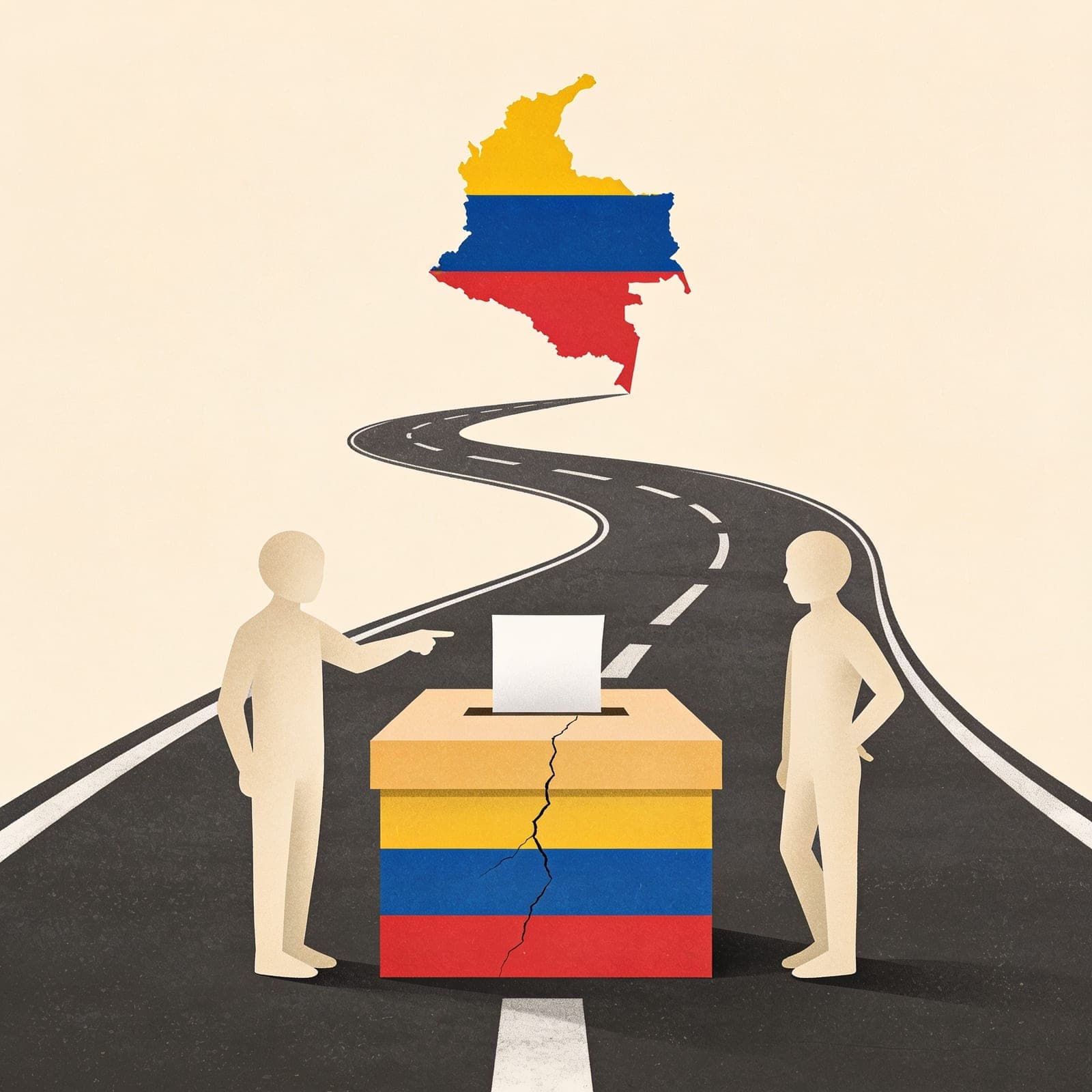
Colombian President Gustavo Petro is refusing to recognize the preliminary results of the May 31 first-round presidential vote, alleging fraud — even though the candidate of his own movement, leftist senator Iván Cepeda, advanced to a June 21 runoff and has publicly said his campaign found no evidence of wrongdoing. The split has opened a rift on Colombia's governing left just two weeks before a second round that could redefine the country's relationship with Washington.
Why is Petro disputing a vote his own side could win?
In the May 31 first round, right-wing outsider Abelardo de la Espriella finished first with 43.74% (10,661,499 votes) and Cepeda second with 40.90% (9,688,361), on 57.9% turnout, according to results compiled on Wikipedia from Colombia's electoral authority. Because no candidate cleared 50%, the two advance to a runoff on June 21.
Petro nonetheless rejected the pre-count. On X he wrote that he would not accept the tally from "the private firm of the Bautista brothers" — a reference to Thomas Greg & Sons, which supplies Colombia's electoral technology — claiming "the algorithms…were modified three times during the last week, and 800,000 additional ID records were added," per Colombia One. He later cited roughly 885,409 new voter registrations added days before the vote. The president has no legal power to accept or reject results — binding tallies come from judge-led counting commissions — so his statements carry no formal weight.
The striking part: the candidate who would gain most from any recount broke with him. "So far, I must say clearly, we have not found evidence or indications of significant irregularities," Cepeda told reporters on June 2 after his campaign reviewed the tabulation, Colombia One reported — a direct contradiction of Petro the same morning.
What does the evidence actually show?
International observers who monitored the vote validated its transparency, and the discrepancies Petro cites are routine. A fact-check by The Bogotá Post found that gaps between the rapid pre-count and the official scrutiny are typically traced to human error rather than software manipulation: the 2022 presidential vote showed a 5.49% pre-count discrepancy caused by a ballot-design error, while March 2026's legislative elections diverged by just 0.28%.
The deeper history is more ambiguous but does not support a fraud finding. A 2018 Council of State ruling found "evidence of destruction of electoral material and inconsistencies" in paper forms from the 2014 elections, The Bogotá Post noted, but the court "could not confirm that voting software had been sabotaged because it did not have access to the source code." Colombia's Registrar's Office argues that building and running a fully state-owned system is not feasible and that publishing the source code would make it more vulnerable to attack.
Who are the two candidates?
The runoff pits two opposite visions of Colombia against each other.
| Iván Cepeda (left) | Abelardo de la Espriella (right) | |
|---|---|---|
| First round | 40.90% (9,688,361) | 43.74% (10,661,499) |
| Base | Historic Pact (Petro's coalition) | Right-wing outsider |
| Running mate | Aida Quilcué, Indigenous leader | José Manuel Restrepo, ex-finance minister |
| Security & drugs | "Total Peace" talks; tackle root causes | Strikes on suspected drug planes and boats; coca fumigation; 10 megaprisons |
| US relations | More independent foreign policy | Closer alignment with Washington |
| Economy | Expand welfare, tax the wealthy | Shrink the state ~40%, cut taxes, expand hydrocarbons |
Cepeda, 63, a veteran human-rights senator whose platform makes some 140 references to Petro and declares "the change has not ended; it has barely begun," is running as the continuity candidate, according to Americas Society/Council of the Americas. De la Espriella, 47, a corporate lawyer and self-styled outsider, rejects Petro's agenda wholesale.
What is at stake for the United States?
The drug trade — Colombia is the world's largest cocaine producer — remains the central axis of the bilateral relationship, and the two candidates would steer it in opposite directions. De la Espriella, who holds dual Colombian-US citizenship, has pledged to join President Trump's "Americas Counter Cartel" initiative and favors a militarized counter-narcotics campaign; Cepeda backs a more independent foreign policy. Trump weighed in directly, offering what an Associated Press report described as his "complete and total endorsement," calling de la Espriella an "intelligent, strong and tough leader" facing a "radical leftist Marxist."
A presidency already testing Colombia's institutions
The fraud dispute lands amid wider strain. On June 4 Petro shelved his campaign for a citizen-led constituent assembly, and on June 2 the Inspector General's office suspended two senior officials — ambassador to Brazil Alfredo Saade and disaster-agency director Carlos Carrillo — for publicly backing candidates, with earlier probes touching ministers Armando Benedetti and Antonio Sanguino, per Colombia One. Atlantic Council analysts Enrique Millán-Mejía and Geoff Ramsey have called the moment "a stress test for Colombia's institutions."
The polls offer no clarity. An AtlasIntel/Semana survey (June 1–2) put de la Espriella ahead 52.51% to 44.47%, while an earlier Invamer poll had Cepeda leading 52.4% to 45.3%; prediction markets favored de la Espriella at roughly 59%. With the electorate fluid and the incumbent contesting the count, Colombia's June 21 runoff is as uncertain as it is consequential.