The numbers were always too good to be true.
In April, Defence Minister Richard Marles stood at the National Press Club and announced what he called Australia's "biggest peacetime increase in defence spending in our nation's history" — a headline figure of $53 billion over a decade, with $14 billion over the forward estimates. He said Australia was spending 2.8 per cent of GDP on defence. He called it transformational.
By the end of May, two independent analyses had quietly demolished the claim. By the first week of June, a Labor backbencher was publicly declaring the government's signature security project was already broken, and a crowd-funded inquiry led by a former cabinet minister was being launched from the forecourt of Parliament House.
This is not a story about a bad week. It is a story about a pattern.
The Disappearing $14 Billion
Let us start with the numbers, because the numbers are extraordinary.
The 2026-27 defence budget is not rising. It is falling. According to the Australian Strategic Policy Institute's authoritative Cost of Defence brief, published on 28 May 2026, the whole-of-government defence spend for the next financial year is $62,595 million — down from $63,243.9 million in 2025-26. That is a decrease of approximately $799 million in nominal terms, or around 3.5 per cent in real terms, according to ASPI. It is the first nominal decrease in the defence budget since the Gillard government's 2012-13 cuts.
ASPI's verdict: "the bottom line is that we're still waiting for the reality to match the rhetoric."
How does a boasted $14 billion increase become a cut? Strategic Analysis Australia defence analyst Marcus Hellyer dissected the Portfolio Budget Statements in detail. Of the claimed $14 billion, about $6.8 billion represents genuine new government appropriation. The remaining $7.2 billion consists of $5 billion in "alternative financing" — private sector investment that may or may not materialise, and which does not appear in the budget papers as actual appropriation — plus $2-3 billion projected from defence estate divestments that remain unquantified. That $5 billion of private capital is not money in the budget. It is a wish.
And the $6.8 billion that is real? It is immediately offset by $3.2 billion in foreign exchange adjustments (the stronger dollar reducing the cost of US equipment purchases), another $2.9 billion in savings harvested from Defence's contractor workforce, and funds reprofiled from forward years into 2025-26 to inflate last year's headline numbers. Net the lot, and the forward estimates baseline over 2026-2030 is actually a $1.2 billion decrease against the pre-NDS baseline — or a $5.5 billion decrease against the 2025-26 budget's own projections, according to Strategic Analysis Australia's analysis.
At Senate Estimates on 27 May, Finance Minister Katy Gallagher confirmed what the budget papers obscured: "none of those [alternative financing] decisions have been finalised." Finance officials made clear that if the private capital or estate sale proceeds do not materialise, the cost falls to Defence — meaning more capability cancellations.
Meanwhile, Senator James Paterson noted from the doorstep of Parliament House on 2 June that, under Australia's own traditional GDP methodology (not the NATO methodology Marles adopted specifically to inflate the headline), defence peaked at 2.13 per cent of GDP in 2025-26 and falls to 2.02 per cent in 2026-27. Two per cent. The same figure Australia has been hovering around for nearly a decade. Marles achieves his "2.8 per cent" figure by using the NATO methodology, which counts military pensions, veteran welfare, and intelligence spending alongside combat capability — as Senator Paterson put it, "unless Richard Marles plans to deploy the IGIS to the frontline in a future war, then this is just pulling wool over the Australian people's eyes."
The Downgraded Deal
At the same time the defence budget numbers were unravelling in Canberra, Marles was in Singapore for the Shangri-La Dialogue — where, on 30 May 2026, he announced alongside US Defence Secretary Pete Hegseth and UK Defence Secretary John Healey that the AUKUS submarine "optimal pathway" had been revised.
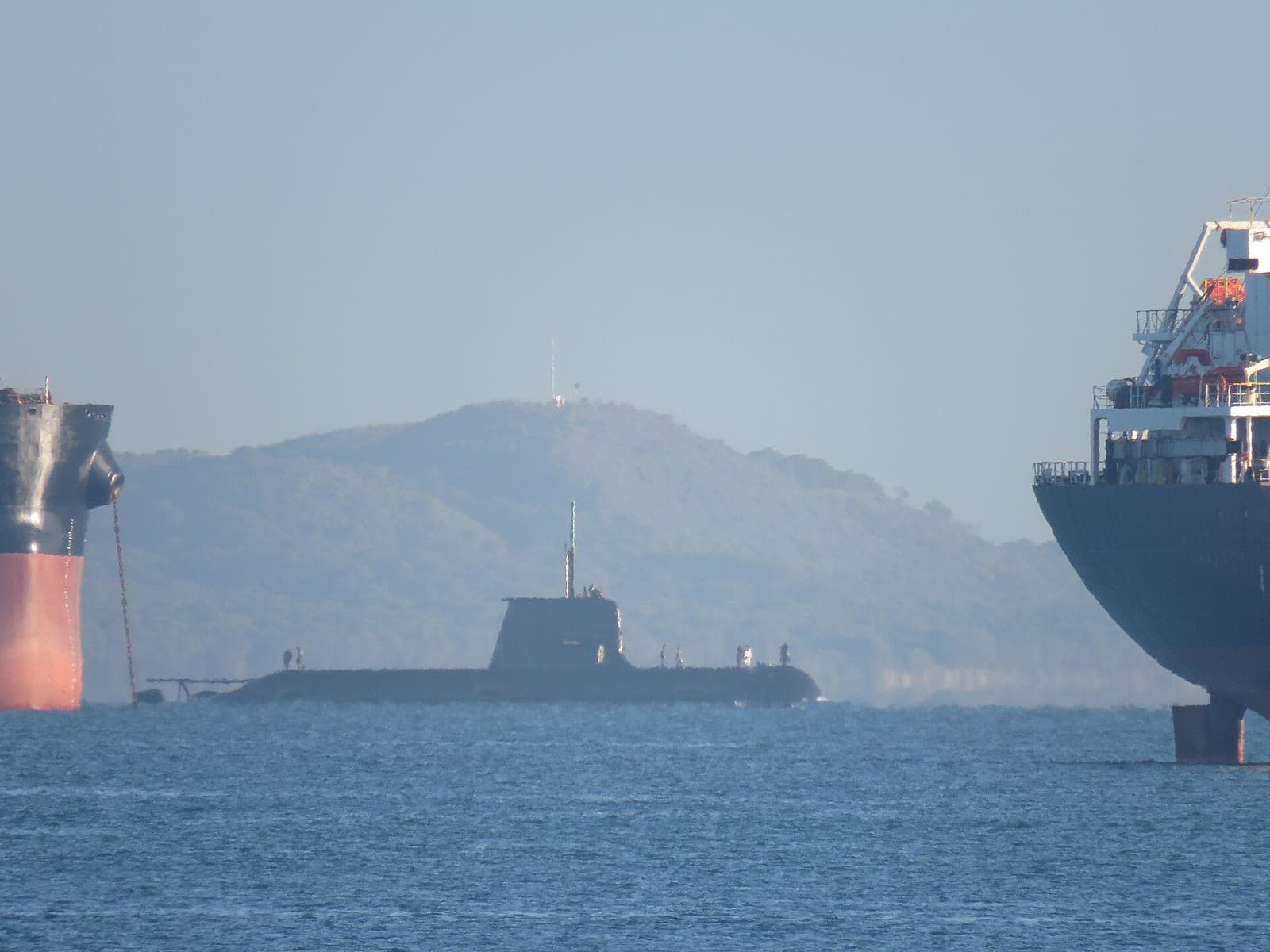
Under the plan announced in 2023, Australia was to receive two used Virginia-class submarines and one newly built Virginia, beginning in the early 2030s, before transitioning to the jointly developed SSN-AUKUS in the 2040s. As of May 30, Australia will now receive three used Virginias — no new build. The single new submarine Australia was promised has been dropped.
Marles called it "simpler and cheaper." He insisted he was "chasing simplicity." Defence Industry Minister Pat Conroy told Labor's caucus the difference between a used submarine and a new one amounted to whether the third boat ended its service life in the 2060s or 2070.
This framing is difficult to accept on its face. The United States is currently producing approximately 1.3 Virginia-class submarines per year, according to USNI News — far below the 2.33 required to simultaneously sustain the US Navy fleet and deliver boats to Australia. Sources familiar with AUKUS deliberations in Washington told The Nightly on 1 June that the change was driven not by Australia but by the Pentagon, influenced by Under Secretary for Policy Elbridge Colby, a longstanding AUKUS sceptic who has sought to protect US production capacity. Australia has already transferred more than $US3 billion ($4.2 billion AUD) to American and British shipyards to help accelerate submarine production — and received no submarines in return. We have paid for a new boat, and received a promise of three old ones.
As ASPI's 2026 Cost of Defence brief notes, with AUKUS absorbing more than $5.4 billion in a single year, the program has become the "centre of gravity" of Australia's entire defence investment, and the country remains "heavily dependent" on US production, technology and decisions. That is a profound strategic vulnerability in an era when the government's own defence assessments describe the security environment as the most dangerous since the Second World War.
Labor's Own Revolt
The person who said it most plainly was not from the opposition. It was Ed Husic.
Husic, a Labor backbencher who served as Industry Minister until he was demoted from cabinet in 2025, stood outside a Labor caucus meeting on 3 June and declared: "We are not going to get the deal that was promised." He had already raised it inside caucus, asking whether the original 2021 caucus resolution endorsing AUKUS — which Albanese had rushed through with "minimum opportunity for consideration," according to The Conversation — still stood, given the programme's material changes. Albanese and Conroy slapped him down. Husic went public anyway.
"You do wonder whether or not we will get the deal, even the reconfigured one that we have got," he told reporters, raising the sovereignty question of what obligations Australia might face from a transactional Trump administration in exchange for three second-hand boats.
The same day — 2 June — former Labor minister and Midnight Oil frontman Peter Garrett held a press conference to announce a crowd-funded "people's inquiry" into AUKUS, led by a panel that includes former Chief of the Australian Defence Force Admiral Chris Barrie (1998-2002) and former WA Premier Carmen Lawrence. The inquiry will hold public hearings in capital cities and report by 30 October 2026. Crossbencher Allegra Spender moved a "Matter of Public Importance" in the House calling for transparency; she was supported by at least six other crossbenchers.
Crossbencher Monique Ryan put it with characteristic economy: "It's a national embarrassment that a former Labor minister is crowdfunding for an independent inquiry into AUKUS."
A Pattern of Spin
The Albanese government has now established a distinctive governing style: announce a large, impressive-sounding number; attach it to a genuine problem (housing affordability, strategic insecurity, cost of living); and trust that the headline will survive longer than the scrutiny.
On CGT and negative gearing reform, the headline was about helping young Australians into homes — but the fine print extends to all assets, was never put to voters, and Freshwater Strategy polling found 45 per cent of respondents said the changes decreased their trust in government. On defence, the headline is "biggest peacetime increase" — but the actual appropriation is a nominal cut, the private financing is unconfirmed, the accounting methodology has been changed specifically to inflate the percentage, and the signature military project has been quietly downgraded.
Governments are entitled to make hard choices. They are not entitled to pretend they haven't.
In the most dangerous strategic environment since the Second World War, Australia's government is asking the Australian Defence Force to, in ASPI's precise words, "carry the deterrence load with less." That is a defensible strategic choice. But as ASPI's 2026 Cost of Defence authors noted, it should be "named for what it is" — not dressed up as a record investment and sold to Australians who are relying on their government to be straight with them.